Quantitative Plant Health
Understanding, predicting and managing plant disease
The Quantitative Plant Health Group (previously Theoretical and Computational Epidemiology) develops mathematical and computational approaches to plant disease epidemiology, biosecurity and risk assessment.
Plant diseases threaten food security, ecosystems and global trade. We combine epidemiological theory, statistical inference and computational modelling to understand how plant diseases spread and to design robust strategies for their detection, prediction and control.
A central theme of our work is decision-making when data are limited, noisy or incomplete. We focus on what can – and cannot – be inferred from imperfect data, and on how decisions can still be made effectively when key quantities are only partially observed.
Our work spans fundamental theory, applied modelling and contributions to plant health policy and risk assessment.
Our research
Our research is organised around four interconnected themes, linking fundamental disease dynamics, biological mechanisms of transmission, and decision-making under uncertainty to plant health policy.
Disease dynamics and epidemiological theory
Understanding how plant pathogens spread through crops, forests and natural ecosystems.
We develop mathematical and computational models to understand how plant diseases spread across scales, from individual hosts to heterogeneous landscapes. Our work combines spatial and stochastic epidemiology with invasion dynamics and transmission processes.
These models provide a framework for inference, prediction and management, and clarify what can be reliably inferred – and what cannot – from incomplete and noisy observations. This insight underpins our work on surveillance, control and policy.
Selected work
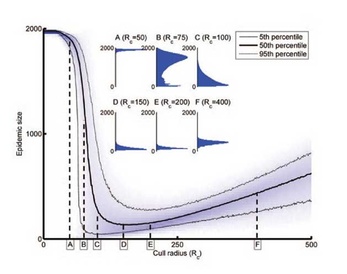
- Cunniffe et al. (2016) PNAS. Landscape-scale spread in natural environments
- Thompson et al. (2018) PLOS Computational Biology. How information about transmission is gained during epidemic spread
- Cunniffe et al. (2024) Springer. Identifiability and observability in epidemiological models
- van den Bosch et al. (2024) Oikos. Basic reproduction number in spatially structured populations
Recent highlight
- Best & Cunniffe (2026) PLOS Computational Biology. Reconstructing spatial transmission processes from epidemic observations
Surveillance, control and resistance management
Designing robust strategies under uncertainty.
A central challenge in plant health is how to design effective management strategies when epidemics are only partially observed.
Our work integrates epidemiological modelling and optimisation to design strategies that remain effective under uncertainty. We explicitly account for operational constraints and the limits of available information, providing a rigorous basis for decision-making and identifying when reliable optimisation is not possible.
Key areas include surveillance and early detection, fungicide resistance management, resource allocation and adaptive control during epidemics, as well as the fundamental limits of optimisation in stochastic systems.
Selected work
- Cunniffe et al. (2015) PLOS Computational Biology. Communicating epidemic and control outcomes under uncertainty
- Hyatt-Twynam et al. (2017) New Phytologist. Risk-based management of invading disease
- Mastin et al. (2020) PLOS Biology. Risk-based surveillance for early detection
- Taylor & Cunniffe (2023) PLOS Computational Biology Polygenic fungicide resistance and crop variety breakdown
Recent highlight
- Russell & Cunniffe (2025) PLOS Computational Biology When optimal control strategies fail to eradicate disease
Plant health, biosecurity and policy
From models to decisions.
We apply epidemiological modelling to inform plant health policy, biosecurity and risk assessment, particularly for emerging and invasive pathogens. This includes contributions to formal risk assessment and policy guidance used in regulatory and advisory contexts.
A particular emphasis is on how uncertainty, partial observability and human behaviour shape policy-relevant decisions, and on how these factors can be incorporated into formal decision frameworks.
Our work contributes to decision frameworks used in national and international contexts, including surveillance design, contingency planning and commodity risk assessment. By integrating epidemiological, economic and behavioural considerations, we translate model-based insight into operationally feasible, policy-relevant recommendations.
Selected work
- Parnell et al. (2015) Proceedings of the Royal Society: Biology. Surveillance for early detection of invading epidemics
- Ristaino et al. (2021) PNAS. Emerging Plant disease pandemics and global risk
- Murray-Watson & Cunniffe (2022) Journal of the Royal Society. Grower behaviour, tolerant varieties and control decisions
- Ellis et al. (2025) Plants, People, Planet. Preparedness modelling for HLB in Europe
Recent highlight
- EFSA Panel (2026). Quantifying plant health risks in international grapevine trade using probabilistic pest freedom assessment
Transmission biology and vector-mediated spread
Biological mechanisms shaping transmission.
We investigate how interactions between plants, pathogens and their vectors shape disease transmission. These mechanisms are essential for linking observed epidemic patterns to underlying transmission processes. A particular focus is how pathogens manipulate host traits and vector behaviour to enhance transmission.
Combining modelling with experimental collaborations, we study mechanisms such as host attractiveness, vector movement and pollinator behaviour. These processes are key drivers of transmission and are therefore essential for predicting epidemic dynamics and identifying opportunities for control grounded in biological mechanisms.
Selected work
- Groen et al. (2016) PLOS Pathogens. Virus-driven changes in pollinator preference
- Donnelly et al. (2019) Ecology. Enhanced long-distance dispersal via pathogen effects
- Cunniffe et al. (2021) PLOS Computational Biology. Virus manipulation of hosts and vectors
- Zaffaroni et al. (2021) PLOS Computational Biology. Vector interference and control
Recent highlight
- Falla & Cunniffe (2024) PLOS Computational Biology. How vector behaviour shapes plant virus transmission dynamics
Publications
View Google Scholar here for a full list of publications.