

More than a spring spectacle, bluebells reveal a mix of chemistry, ecology and conservation beneath their familiar blue.
Every April, Britain’s woodlands are transformed by one of spring’s most anticipated spectacles: the beautiful British bluebell (Hyacinthoides non-scripta). Behind this cultural icon lies a plant with a fascinating biology.
In recognition of International Plant Appreciation Day we've teamed up with scientists and horticulturists from the Cambridge University Botanic Garden, the Cambridge University Herbarium and the Sainsbury Laboratory Cambridge University to explore the science behind the British bluebell.
Contributors: Jean Watelet, Juliet Anderson, Sally Petitt, Edwige Moyroud.
Is a bluebell really blue?
Bluebells are celebrated for their deep violet-blue flowers.
Their appeal is no surprise: blue is one of the rarest colours in nature, found in fewer than 10% of flowering plants.
This is possibly because blue pigments require plants to use a sophisticated chemistry toolkit to both synthesise and to stabilise their blue colour.
The colour that we perceive as blue in bluebells is produced by flavonoid compounds from the anthocyanin family.
Anthocyanin pigments range from vivid red to deep purple, with their exact hue influenced by several factors, including the pH inside the plant cell’s vacuole (appearing red in acidic conditions and blue in more alkaline environments), the addition of chemical decorations that influence light absorption/reflection and the presence of other flavonoids. Interactions between those pigments and metallic ions can also enhance blue tones, depending on their availability in the soil.
The anthocyanin that gives bluebells their characteristic hue is delphinidin. Delphinidin is the primary pigment also responsible for the blue hues of delphiniums, Himalayan blue poppies and violas/pansies. Delphinidin has three hydroxyl decorations attached to it, which shifts the colour towards purple and blue.
This is not merely aesthetic. Blue and violet tones are highly visible to pollinators, such as bees and bumblebees, meaning that flowers capable of producing these colours may catch their attention more easily.
In bluebells, colour also changes over time: younger flowers display a richer blue, fading as they age. This is possibly a signal to pollinators that the flower is past its prime. It could also simply be that pH regulation in the vacuole is less efficient in older flowers.
There are occasional mutations of the enzymes responsible for anthocyanin pigment production and decoration, which can lead to plants with pink or white flowers.
A species under pressure
Beneath the beauty of the bluebell lies a more fragile story.
The British bluebell is native across much of the UK and occurs in calcareous and slightly acidic woodland. They start growing early in the year while most plants are still dormant. Even in low temperatures, they rapidly produce leaves, complete flowering and produce seeds before the tree canopy closes over and blocks out sunlight. This allows them to capture maximum light to store as energy in the bulb for next year’s flowers.
In England, bluebells can be indicative of ancient woodlands, which have persisted undisturbed since the 1600s, and which have developed unique communities of plants, fungi, lichen, insects, birds and mammals.
However, they face several pressures, including habitat loss and hybridisation with non-native relatives.
One long-standing concern is interbreeding with introduced relatives, especially the so-called Spanish bluebell (Hyacinthoides hispanica) thought to have arrived in Britian in the late 1600s to 1700s. This non-native species actually originated from Portugal, not Spain and has interbred with native populations, producing hybrids (Hyacinthoides x massartiana) that are now common in gardens and parks around the UK.
However, recent genetic studies by the Royal Botanic Garden Edinburgh provide some reassurance. While hybrids are now widespread, there is currently no strong evidence of large-scale genetic swamping in natural populations, finding only 2% of natural native populations showed evidence of hybridisation. In fact, native British bluebells may have higher fertility than their hybrid counterparts, suggesting they retain a competitive edge in suitable habitats.
How to identify a true British bluebell
Distinguishing between native, Spanish and hybrid bluebells is not always straightforward. British bluebells typically have a drooping stem with flowers arranged on one side, narrow tubular flowers with strongly recurved tips, and cream-coloured anthers and pollen. They have a sweet perfume.
In contrast, Spanish bluebells are more upright, with flowers arranged around the stem and have blue-grey anthers. Usually no perfume. Hybrids often display a mix of characteristics from both British and Spanish bluebells.
British bluebells can be found in Cambridge University Botanic Garden dotted along the boundaries and long grass areas. There are not dense plantings and are variable due to hybridisation.
Not all bluebell woods are publicly accessible, so it’s always wise to check if access is permitted before entering. It is illegal to pick them without the landowner’s permission. Under the Wildlife and Countryside Act 1981, digging up bulbs can result in a fine of £5,000 per bulb.
What’s in a name?
Like all plants, the British Bluebell also has its taxonomic binomial name, Hyacinthoides non-scripta, however it has been known by many different names over time.
Historically taxonomists would describe new scientific species based off key morphological characteristics of the plant, however with the advent of genetic techniques it has often been found that many plants which were historically thought to be different species, are all the same. These species are then bought together under one ‘correct’ name (in this case Hyacinthoides non-scripta), and the other names become known as synonyms.
Many of these name changes are captured by herbarium specimens, dried plants that can be hundreds of years old, many of which are still annotated with their historic names.
An unusual example of this is a Cambridge Herbarium specimen CGE00075962, which captures eight of the historic names used for this species on its label, showcasing its complicated taxonomic history. Another nice example is specimen CGE00075950, which was originally collected in 1832, and is annotated with three different names, the most recent being the correct Hyacinthoides non-scripta.
Herbarium specimens provide a valuable resource that record the locations and flowering time of bluebells and other plants over long periods of time, providing historic records for tracking plant phenology and response to climate change.
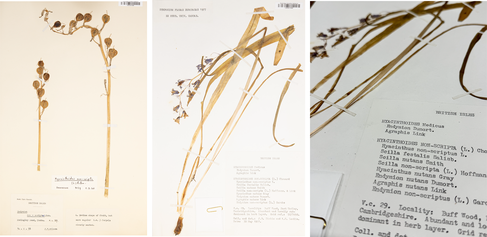
Some examples of the herbarium specimens of bluebells held by the Cambridge University Herbarium: (Left) Herbarium specimen (CGE00075946) showing the fruit of the British bluebell (Hyacinthoides non-scripta). (Centre and Right) Herbarium specimen (CGE00075962) collected locally in Cambridge, with different synonyms for Hyacinthoides non-scripta listed on the label (centre and right). Imaged by Weina Jin (CGE).
Facts you (probably) never knew about bluebells
- Cold-ready chemistry: Store energy in their bulbs as fructans (not starch), to fuel early spring growth below 10°C.
- Slow starters: Can take 5-7 years from seed germinating to first flower.
- Play tricks: Look like they have 6 violet-blue petals but actually only have 3! The 3 outer sepals (normally green and leaf-like in most flowers) are identical to the petals, producing a bluebell flower with 6 ‘apparent’ petals. Petals and sepals that looks identical are known as ‘tepals’.
- Hidden seeds: Mainly reproduce by seed, each plant producing up to 100 seeds, but the seed capsules and seeds are rarely noticed. These often-unseen fruits have been preserved in some of the specimens kept in the University Herbarium, an example of which can be seen in the Herbarium specimens pictured.
- Self-burial system: Contractile roots pull bulbs down deeper into the soil, protecting the bulb from frost or heat.
- Fit for a queen: A vital early nectar source for bumblebee queens, although some cheat by ‘robbing’ nectar by making holes at the base of the flower and bypassing pollination.
Plants at Cambridge
Cambridge is a world-leading centre for plant biology and is home to one of the largest concentrations of plant research globally.
Plants at Cambridge brings together plant scientists from across the University and beyond, with a shared vision of transforming ground-breaking discoveries into real-world solutions for some the planet’s most urgent challenges.
The following organisations contributed to this feature:
- Department of Plant Sciences: Professor Beverley Glover’s research group studies the evolution and development of floral traits, including structural colour and petal patterns.
- Cambridge University Herbarium: The fourth largest herbarium collection in the UK, our estimated 1.1 million dried plant specimens provide a window into the past, a record of three centuries of plants, their environments and the people who collected them.
- Cambridge University Botanic Garden: We hold a living collection of plants from all over the world for scientific research and teaching, as well as for the enjoyment of our visitors.
- Sainsbury Laboratory Cambridge University: We are dedicated to understanding how plants develop and adapt to their environment. Our focus is on the regulatory mechanisms that control plant development across scales, from gene networks and signalling pathways to tissues and whole plants.
Top image: A British bluebell flower (Hyacinthoides non-scripta) imaged under a digital white light microscope reveals how the flower is structured with 3 sepals and 3 petals that create the bell-shape. Zooming in, a scanning electron microscope uncovers intricate structures invisible to the naked eye, from the delicate papillae on the stigma and pollen grains to the moment anthers split open to release pollen. Images by Gareth Evans and Trevor Groves FRMS.